How to Read a GIA Certificate: What Every Diamond Buyer Needs to Know
A GIA certificate is the most trusted document in the diamond industry — but most buyers don't know how to read one. This guide walks you through every section of a GIA grading report in plain English, so you can make a confident, informed decision before you buy.
How to Read a GIA Certificate: What Every Diamond Buyer Needs to Know
There was a time when buying a diamond meant trusting a jeweler completely. You walked in, they told you it was beautiful, and you paid. Most buyers had no way to verify what they were being told.
The GIA certificate changed that. Introduced by the Gemological Institute of America, it became the industry's most trusted independent verification of a diamond's quality. Today, any serious diamond purchase should come with one — and any buyer can learn to read it.
This guide walks you through every section of a GIA grading report in plain English. No jargon. No assumptions. Just what each number and grade means, and why it matters for the piece you're buying.
What Is a GIA Certificate?
A GIA certificate — formally called a GIA Diamond Grading Report — is an independent assessment of a diamond's quality produced by the Gemological Institute of America, a nonprofit research and education organisation that has been grading diamonds since 1931.
The GIA does not buy or sell diamonds. It has no financial interest in the grades it assigns. That independence is what makes a GIA report the gold standard in the industry — it is as close to an objective assessment of a diamond as you can get.
When you receive a GIA certificate, you are receiving a document that tells you exactly what you are buying. Your job is to understand what it says.
The Report Number
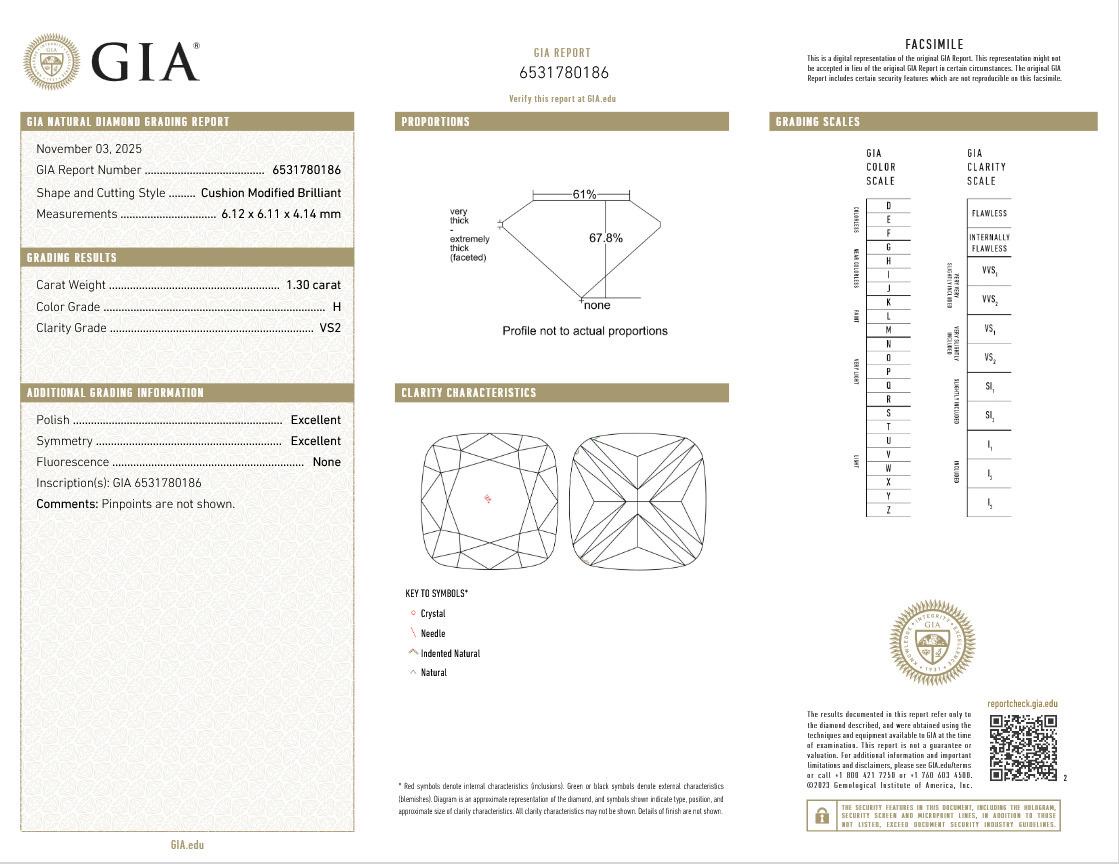
At the top of every GIA certificate is a unique report number. This number is also laser-inscribed on the diamond's girdle — the thin edge around its circumference — so you can verify that the certificate matches the specific stone in your hand.
To verify a report, go to gia.edu and enter the report number in their report check tool. This takes thirty seconds and confirms the certificate is genuine. Always do this before finalising a purchase.
The 4Cs — Cut, Color, Clarity, Carat
The majority of a GIA certificate is devoted to grading the diamond across four categories known as the 4Cs. These were developed by the GIA itself in the 1940s and have since become the universal language of diamond quality.
Cut
Cut is the most important of the four categories, and the one most buyers underestimate. It refers not to the shape of the diamond — round, oval, emerald — but to how precisely the diamond has been faceted. A well-cut diamond reflects light back through the top with maximum brilliance. A poorly cut diamond loses light through the sides and bottom, appearing dull regardless of its color or clarity.
GIA grades cut on a scale of Excellent, Very Good, Good, Fair, and Poor. For round brilliant diamonds, Excellent cut is the standard to aim for. For fancy shapes — oval, pear, marquise, emerald — GIA does not assign an overall cut grade, so you will need to evaluate the proportions yourself or rely on your jeweler.
Color
Diamond color is graded on a scale from D to Z, where D is completely colorless and Z has a noticeable yellow or brown tint. The scale is counterintuitive — lower letters mean more color, which is generally considered less desirable in a white diamond.
In practice, the difference between adjacent grades is almost impossible to detect with the naked eye. At Amber Arc, we hold a color floor of F-G on all pieces we produce. This range sits in the near-colorless category — the diamonds appear white to the eye but are priced significantly lower than D-E stones that offer no visible advantage in a finished setting.
Clarity
Clarity refers to the presence of inclusions — internal characteristics — and blemishes — surface characteristics — in the diamond. GIA grades clarity on the following scale:
Flawless and Internally Flawless — no inclusions or blemishes visible under 10x magnification. Extremely rare.
VVS1 and VVS2 — very very slightly included. Inclusions are extremely difficult to see even under magnification.
VS1 and VS2 — very slightly included. Inclusions are minor and difficult to see under magnification. This is the sweet spot for most buyers.
SI1 and SI2 — slightly included. Inclusions are noticeable under magnification and may be visible to the naked eye in SI2 stones.
I1, I2, and I3 — included. Inclusions are obvious under magnification and affect transparency and brilliance.
At Amber Arc, our clarity floor is VS — meaning every diamond we use has inclusions that are minor and not visible to the naked eye in a finished piece.
Carat
Carat is the measure of a diamond's weight. One carat equals 0.2 grams. Larger diamonds are rarer and therefore more expensive, but carat weight alone does not determine a diamond's value — a 1.5 carat diamond with poor cut, color, and clarity can be worth significantly less than a 1 carat diamond with excellent grades across the board.
One important note: carat weight and physical size are related but not identical. Two diamonds of the same carat weight can appear different sizes depending on their cut proportions. A well-cut diamond will appear larger than a poorly cut one of the same weight because more of its mass is distributed across the top face.
The Proportions Diagram
Below the 4Cs grades, a GIA certificate includes a diagram showing the diamond's proportions — table percentage, depth percentage, crown angle, pavilion angle, and girdle thickness. These numbers matter most for round brilliant diamonds, where they directly affect the cut grade.
For practical purposes, if the diamond has received an Excellent or Very Good cut grade from GIA, the proportions are already within an acceptable range. You don't need to calculate these numbers yourself.
The Clarity Plot
The certificate includes a diagram of the diamond — a top view and a side view — with symbols indicating the location and nature of inclusions and blemishes. Each symbol represents a different type of characteristic: a feather, a crystal, a cloud, a needle, and so on.
The clarity plot tells you where the inclusions are, not just whether they exist. An inclusion at the edge of the diamond, partially hidden by a prong in the setting, is far less visible than an inclusion in the center of the table. This is worth noting when comparing stones of the same clarity grade.
The Fluorescence Grade
Fluorescence refers to how a diamond reacts when exposed to ultraviolet light. GIA grades it as None, Faint, Medium, Strong, or Very Strong, and also notes the color of the fluorescence — most commonly blue.
Fluorescence is one of the most misunderstood characteristics in diamond buying. In some stones, strong blue fluorescence can make a slightly warmer diamond appear whiter in daylight, which can actually be a benefit. In others, it can create a slight haziness. The effect varies by stone.
For most buyers, None to Faint fluorescence is the safe choice. Medium to Strong fluorescence is worth examining in person before purchasing if possible.
The Shape and Cutting Style
The certificate specifies the diamond's shape — Round Brilliant, Oval Modified Brilliant, Emerald Cut, Princess Cut, and so on — as well as the cutting style. This confirms you have the stone described.
Why the GIA Certificate Matters for Your Purchase
A GIA certificate is not a guarantee that you will love the diamond. Two stones can have identical grades and look completely different — because cut quality has nuances the certificate doesn't fully capture, and because beauty is ultimately subjective.
What the certificate does guarantee is that the grades assigned are accurate and independent. You are not relying on the seller's description. You have a document you can verify, compare, and reference.
At Amber Arc, every natural diamond piece we produce is accompanied by its GIA or IGI certification. We believe you should know exactly what you are buying before you buy it — not because we are required to tell you, but because that transparency is the foundation of a purchase you'll feel good about for the rest of your life.
If you have questions about a specific certificate or want guidance on choosing between stones, we are here to help. That conversation costs nothing and comes with no pressure.
Browse our certified diamond jewelry at amberarcjewelry.com